ASTM B117 Salt (Fog)
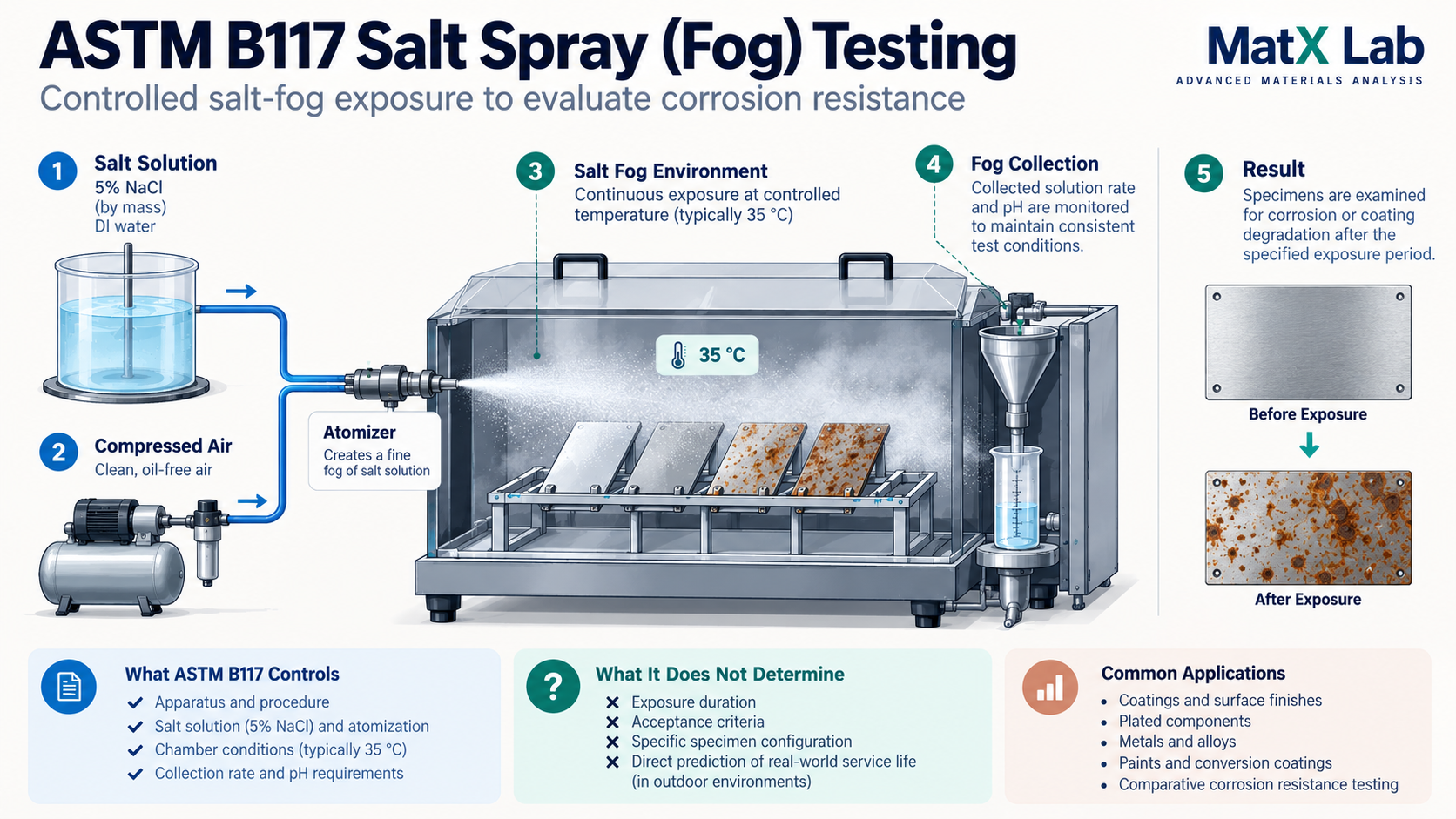
ASTM B117 salt spray testing exposes specimens to a controlled salt-fog environment to evaluate corrosion behavior and coating performance. The practice defines the apparatus, procedure, salt solution, chamber conditions, and collection controls, while exposure duration and acceptance criteria are established by the applicable product, coating, or procurement specification.
The ASTM B117 test subjects specimens to continuous salt spray from a 5% salt water solution at 35 °C within an enclosed chamber. This practice standardizes the apparatus, salt concentration, and operating parameters, leaving the time of exposure and criteria for acceptance to be decided by you or your specification. MatX Lab offers B117 testing on coated steels, plated fasteners, aluminum assemblies, and painted panels according to ASTM B117/ISO 9227 standards.
What Is ASTM B117?
B117 is the ASTM standard test method for salt spray (fog) testing. In this test, specimens are placed in a chamber at a certain angle, and a nozzle creates salt fog using a 5% sodium chloride solution. The chamber temperature is set at 35 °C, and the salt fog collected should be at a pH level of 6.5 to 7.2 with a rate of 1.0 to 2.0 mL per hour per 80 cm².
Review what the practice does not tell you. B117 makes no reference to the amount of exposure time, has no pass/fail criteria, and makes no predictions about service life. You get that from your own spec. The practice provides the repeatability in the box, and the correlation you make within that box is as good as your controls.
ASTM B117 Scope and Applications
This process is ideal for metals and the coatings applied to them, including zinc plating, zinc nickel plating, phosphates, chromates, powders, e-coats, wet paints, and anodized aluminum.
Four uses cover most of the work that comes through:
- Specification compliance: Meeting a stated hour requirement, such as 96 hours to white rust or 500 hours to red rust on a plated fastener.
- Lot and process control: Confirming that a plating line, pretreatment bath, or coating batch still performs the way it did when qualified.
- Comparative screening: Ranking candidate coating systems against one another under identical exposure.
- Failure investigation: Reproducing a corrosion mode reported in the field to check whether a process change caused it.
Alternating wet/dry/humidity exposure is classified under ASTM G85. Coatings that require humidity exposure instead of salt are classified under ASTM D2247. Standard exposure times include 24, 48, 96, 240, 500, and 1000 hours; any subsequent longer time periods follow suit of these standard intervals.
ASTM B117 Test Procedure
Chamber conditions decide whether your data means anything. We verify them before the exposure starts and keep verifying while it runs.
| Step | What happens |
| Specimen preparation | Panels and parts are identified, cleaned as instructed, and edges are protected with tape or wax where the specification calls for it. |
| Scribing | Coated panels receive a scribe through to substrate when creep from a defect is the property under study. |
| Racking | Specimens are supported at 15° to 30° from vertical, positioned so that fog reaches all faces and no specimen drips onto another. |
| Chamber setup | The chamber holds 35 °C. The air saturator tower runs hotter so the atomized fog does not dry the chamber, and solution feed is verified. |
| Fog verification | Collectors placed in the sample zone confirm collection rate and pH before the clock starts, and readings continue daily through the exposure. |
| Exposure | The fog runs continuously. The chamber opens only for scheduled inspection, and every opening is logged with its duration. |
| Interim inspection | Specimens are examined at agreed hold points, photographed, and returned to the chamber in the same orientation. |
| Removal and rating | Specimens are gently rinsed, dried, and rated against ASTM D1654 for scribe creep, ASTM D610 for rust, and ASTM D714 for blistering. |
Limitations: B117 will not predict outdoor service life, and the correlation between hours in the chamber and life in the field varies so much by coating system that the procedure itself avoids making this assertion. Continuous moisture is not encountered in actual service, which is why some coatings surviving 1000 hours in the chamber fail quickly in service, while others that fail early perform successfully. Specimen location within the chamber influences the outcome; therefore, specimens should be rotated during long-term exposures. The scribe that you make determines the kind of failure that you will get, and an irregular scribe will give you an irregular creep.
ASTM B117 Test Conditions Sample Requirements
| Parameter | Typical requirement |
| Panel dimensions | 75 mm x 150 mm standard, larger panels accepted within rack capacity |
| Replicates | Three per condition minimum, five when a specification demands statistics |
| Solution | 5% NaCl by mass in reagent water, pH 6.5 to 7.2 as collected |
| Chamber temperature | 35 °C, held within 2 °C |
| Fog collection | 1.0 to 2.0 mL/h per 80 cm² of collecting area |
| Specimen angle | 15° to 30° from vertical |
| Exposure duration | Set by your specification, commonly 96, 240, 500, or 1000 hours |
Parts with complex geometry need a conversation before they ship. Threaded fasteners, welded assemblies, and anything with a crevice trap solution and drain unpredictably, which changes what the exposure actually does to them.
Tell us the acceptance criteria at quotation. A 1000-hour exposure that gets rated against the wrong standard costs six weeks.
ASTM B117 Test Results and Reporting
Your report indicates the exposure hours completed, the test chamber conditions recorded during the test run, and the condition of each individual specimen at every inspection point.
The ratings are given in the format required by your specifications: scribe creep in millimeters per ASTM D1654, rust rating per ASTM D610, blister diameter and density per ASTM D714. Photographs are included with each individual specimen at removal, and photographs of intermediate inspections are taken when exposure exceeds 240 hours.
Where a control panel ran alongside your samples, its result appears in the same table. That comparison carries the interpretation, since it separates a coating problem from a chamber problem.
ASTM B117 FAQs
ASTM B117 FAQs
How many salt spray hours equal a year outdoors?
The conversion method is not reliable. ASTM B117 states, “this practice will not predict service performance,” and “the ratios vary by an order of magnitude” according to the type of coating. The number of hours should be used for comparative purposes only.
What is the difference between B117 and G85?
However, B117 creates a continuous fog only. The ASTM G85 method includes modifications where the solution is made acidic, SO2 is added to the solution, or where fogging and dry periods are alternated, which better mimics the natural behavior of some coating systems.